How to start a vending business
The usual order is: decide if the work suits you, find a site, run the numbers, sort the paperwork, then buy the machine. Doing those in reverse is how people end up with a machine and nowhere good to put it.
1. Be clear on what the job is
A machine sells without a person standing beside it, but it does not run itself. Someone has to buy stock, drive to the site, refill, clean, collect cash, clear jams, answer complaints and keep records. Sales can be low, and a slow machine still costs money. Treat it as a small business you work in, not a hands-off income.
2. Find the site first
The site decides most of what follows: which machine fits, what you can sell, and whether anyone will buy. Look for places where people stay for hours and have few other food or drink options nearby. Our locations guide covers how to judge and approach one.
3. Run the numbers on that site
Before committing, work out how many sales a month you need to cover your costs. Use the free break-even calculator with your own figures, then read what the costs usually are and how commission changes them. If the sales you need look unrealistic for the site, it is cheaper to find that out now.
4. Sort the paperwork
In the US there is no single federal vending license. What you need depends on where each machine stands, so expect some mix of:
- A business registration, such as a sole proprietorship or LLC. Ask an accountant which suits you.
- An EIN, which the IRS issues free.
- A seller's permit or sales tax license from your state. Vending sales are generally taxable, but the rules vary, so confirm yours.
- Local licenses. Many cities and counties have a vending permit or business license, sometimes per machine. A permit from one city usually does not carry over to another. Ask the local clerk's office.
- Health department approval if you sell perishables such as milk or fresh sandwiches. Machines with only shelf-stable snacks usually do not need it, but check.
- Liability insurance. Not a license, but property owners often ask for it before they sign.
Once you own or operate 20 or more machines, FDA calorie disclosure rules apply to the food you sell. Operators with fewer machines are covered only if they register voluntarily. Outside the US, ask your local tax office and council what applies.
5. Choose the machine to fit the site
A break room with no fridge nearby may suit a combo machine. A site with little space may need something smaller. New machines come with support and usually card payments. Used machines cost less up front and carry more risk, so read what to test on a used machine before you buy one.
6. Plan how people will pay
Many customers expect to tap a card or phone. Check that the machine can take a card reader, that mobile signal is strong at the exact spot, and that you have allowed for the fees.
7. Put the deal in writing
Even for a friendly site, get a short signed agreement covering commission, access, who pays for power, the term and how either side can end it. The commission guide lists what to cover.
8. Track every visit from day one
Record sales, stock, cash and faults per machine. Records tell you what sells, when to visit and whether the site is earning its place. They also make tax time much easier.
Be careful with "turnkey" offers
The US Federal Trade Commission names vending pitches among the common business opportunity warning signs. Under its rule, sellers of covered opportunities must give you a one-page disclosure document at least seven days before you sign or pay, and any earnings claim needs a separate written statement. Phrases such as "up to" still count as earnings claims. Pick your own references to call, and be wary of promised locations. The FTC has acted against companies that took fees to find sites and then did little or nothing.
If you want the worked-out version
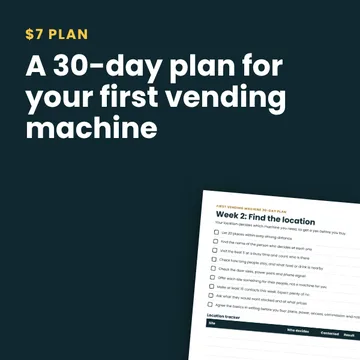 First Vending Machine 30-Day PlanA week-by-week plan for deciding, budgeting and starting a first machine.
 The Vending Operator's ManualThe full 35-page written guide to running machines.
 Complete Vending Business BundleThe manual, calculator, tracker and pitch pack together.
Sources
Checked November 2026. Several are sellers of machines or readers, so treat their prices as a starting point and get your own quotes.
- How to get a vending machine license, Vending.com
- Vending machine labeling requirements, US Food and Drug Administration
- Bogus business opportunities, US Federal Trade Commission
- Business Opportunity Rule guide for sellers, US Federal Trade Commission
- Providers of locations ordered to stop misrepresentations, FTC, 2007
- Pricing and financing guide, Vending.com (a machine seller)